
The Karnataka government told the Supreme Court on Wednesday that the state has not touched any "religious aspect" in the hijab ban row and that the restriction on wearing the Islamic headscarf is limited to the classroom.
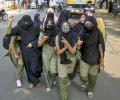
Asserting that hijab is the "identity" of Muslims, senior advocate Dushyant Dave told the Supreme Court on Monday that various acts of omission and commission like Karnataka's headscarf controversy showed a "pattern to marginalise the minority community".

Two other teachers who were the centre superintendents were also placed under suspension.

The police have launched a crackdown against the use of directional loudspeakers (devices that focus sound in a specific direction) at religious structures in Mumbai pursuant to a court order.
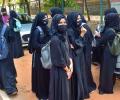
Citing popular protests in Iran, an Islamic country, against the mandatory use of hijabs, he claimed that religion freedom in India cannot mean promotion of "separatist" designs.

The Ameer-E-Shariat Karnataka, Maulana Sagir Ahmad Khan Rashadi, has called for a state-wide bandh on Thursday over the verdict of the high court ruling that the hijab was not essential to the practice of Islam.
A person has a right to practise religion but the question is whether it can be taken to a school which has a prescribed uniform, the Supreme Court observed on Monday while hearing the Karnataka hijab ban row.
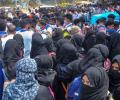
A fresh plea was filed in the Supreme Court on Thursday challenging the Karnataka high court verdict which dismissed the petitions seeking permission to wear a hijab inside the classroom saying hijab is not a part of the essential religious practice in Islam.
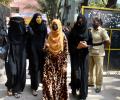
The Supreme Court on Tuesday agreed to consider listing pleas challenging the Karnataka high court verdict which had dismissed petitions seeking permission to wear hijab inside the classroom.
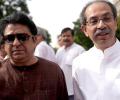
'Raj Thackeray is working at the behest of Chief Minister Devendra Fadnavis.'
Asking a pre-university schoolgirl to take off her hijab at her school gate is an "invasion" of her privacy and dignity, Supreme Court judge Justice Sudhanshu Dhulia said on Thursday.

The Supreme Court on Friday referred the issue of the practice of excommunication in the Dawoodi Bohra community to a larger nine-judge bench.
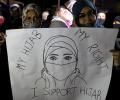
"The girls are losing out on studies," lawyer Prashant Bhushan said.

'When I undertook a study of temple desecration in precolonial India, it was not enough simply to document what temples were desecrated, by whom, when, and where.' 'It was also important to explore the total historical context of such incidents, with a view to discovering patterns, which in turn could reveal the reasons why they occurred.'
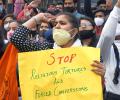
Justice Vinod Diwaker made the observation while rejecting a plea to cancel an FIR against four people accused under the Uttar Pradesh Prohibition of Unlawful Religious Conversion Act, 2021.
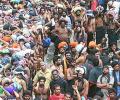
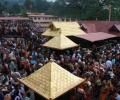
The Supreme Court on Wednesday will hear a plea against restricting women's entry in Kerala's Sabarimala temple.
A bench of Justices Navin Chawla and Shalinder Kaur rejected the petition by the Indian Army Lieutenant, who served as a 'Troop Leader' of a squadron, against the termination order passed on March 3, 2021, that dismissed him from the Indian Army without pension and gratuity.
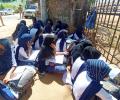
Mehta told a bench of Justices Hemant Gupta and Sudhanshu Dhulia the PFI started the social media campaign over the Islamic headscarf earlier this year and there were continuous social media messages asking students to "start wearing hijab".
The Supreme Court on Wednesday said that the question in the Karnataka hijab ban matter is only about the restriction in schools as nobody is prohibited from wearing it anywhere else they want.
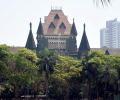
The Bombay high court on Sunday dismissed a public interest litigation (PIL) filed by four students against the Maharashtra government's decision declaring a public holiday on January 22, on the occasion of the Ram temple consecration ceremony in Ayodhya.

The apex court said banning entry of women to Kerala's Sabrimala temple is gender discrimination and the practice violates rights of Hindu women.
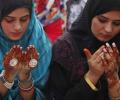
The SC is dealing with legal and constitutional issues relating to discrimination against women in various religions and at religious places including Kerala's Sabarimala Temple.
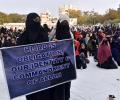
A bench comprising Chief Justice D Y Chandarchud, and Justices V Ramasubramanian and J B Pardiwala, took note of the submissions of senior advocate Meenakshi Arora that an interim order was needed keeping in mind the practical examinations, scheduled for some classes from February 6 in the state.

However, the court directed the authorities to implement the 'Noise Pollution Rules' related to loudspeakers and file a compliance report.

The Karnataka high court, which dismissed a batch of petitions by some Muslim girls from Udupi seeking permission to wear the hijab inside classrooms of educational institutions, framed the entire case in the form of four questions and answered them accordingly.

Challenging the government order restricting the use of any cloth that can disturb peace, harmony and, law and order, the girls who petitioned in favour of hijab requested the Karnataka high court on Monday to allow them to wear Islamic headscarves of the colour of the school uniform.

Of the three girl students, two had held a press meet and questioned the decision of the university to strictly implement the uniform rule inside the campus.
The Supreme Court on Friday said it will set up a three-judge bench to hear a plea of Muslim girl students to sit for examinations in Karnataka government schools while wearing hijab.

A memorandum demanding action was submitted to the varsity by the Hindu Jagran Manch after a video clip surfaced.
The Karnataka high court on Thursday asked the counsels in the hijab case to wind up their arguments by Friday as it indicated that it will shortly deliver the order.
Llast week the girls came to the college in Puttur Taluk of Dakshina Kannada district wearing Hijab and protested demanding permission to wear the headscarf.
The Supreme Court on Thursday reserved its verdict on a batch of petitions challenging the Karnataka high court judgment refusing to lift the ban on hijab in educational institutions of the state.

The Board, which also comprise the state government nominees, told a five-judge Constitution Bench headed by Chief Justice Ranjan Gogoi that it is high time that a particular class not be discriminated on the ground of 'biological attributes'.

The impact of the bandh called by Ameer-E-Shariat Maulana Sagir Ahmad Khan Rashadi, was visible in areas with predominantly Muslim population in cities across the state, where shops, eateries and restaurants were shut till evening.
The Supreme Court is scheduled to pronounce its verdict on Thursday on a batch of petitions challenging the Karnataka high court judgment refusing to lift the ban on hijab in educational institutions of the state.

The girls insisted that they should be allowed to write the exam wearing hijab but the college authorities citing the High Court order denied them entry.

The bench said the review petition can only be taken up after the Dussehra vacation.
Forty Muslim girl students from Udupi district of Karnataka abstained from appearing for the first pre-university examination on Tuesday as they were apparently hurt by the recent high court verdict against wearing of hijab inside classrooms.

The Rajasthan high court had in August made Santhara punishable under section 306 and 309 IPC (abatement of suicide).
Earlier the court had noted that there were 19 review petitions pending in the matter.
